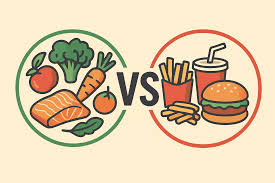
Healthy vs Junk Food

By Dr Dhananjay Sharma, Associate Professor, Amity Institute of Dietetics and Applied Nutrition, Amity University Gurugram
Introduction: A key element of community health governance is public health nutrition policy, which uses coordinated government action to improve dietary habits, overall nutrition, and long-term health outcomes. It works at the nexus of public health, political engagement, social equity, and nutrition science, converting dietary and disease evidence into programmatic, financial, and regulatory interventions. In a time when malnutrition, micronutrient deficiency, obesity, and non-communicable diseases associated with diets coexist, public health nutrition policy has emerged as a vital instrument for tackling intricate and dynamic nutritional issues on a large scale.
Fundamentally, public health nutrition policy describes the governmental decisions and actions that have the authority to affect the availability of food, accessibility, affordability, and acceptability in ways that enhance health and prevent disease. Policy approaches address the underlying causes of dietary behavior, including food chains, markets, organizations and social norms, in contrast to individual-level nutrition interventions. Because dietary decisions are influenced by economic, environmental, religious, and political factors rather than being made in a vacuum, this population-specific focus is crucial. Growing awareness of these factors has caused nutrition policy to change from focusing solely on individual accountability to more comprehensive approaches that foster healthy eating environments.
Epidemiological and clinical data concerning diet and health outcomes serves as the scientific foundation for public health nutrition policy. Numerous studies have shown links between dietary habits and the primary root causes of mortality and morbidity, such as obesity, type 2 diabetes, cardiovascular disease, and some types of cancer. As a result, governments rely on professional advisory groups to integrate nutrition research into dietary recommendations that guide policy choices. While recommending restrictions on sugary products, sodium, and unhealthy fats, these recommendations usually encourage a higher intake of vegetables, whole grains, fruits, and legumes. However, it is neither simple nor politically neutral to convert dietary recommendations into sensible policy. Scientific evidence is frequently weighed against industry influence, cultural preferences, and economic interests.
Regulation of food environments is one of the most important areas of public health nutrition policy. The goal of policies like taxes on sugar-sweetened beverages, reformulation targets, mandatory nutrition labeling, and prohibitions on marketing unhealthy foods to children is to change the environment in which dietary decisions are made. Research indicates that these actions, when taken as part of an all-encompassing policy package, may help improve population diets in a small but significant way. For instance, it has been demonstrated that front-of-pack labeling systems enhance consumers' comprehension of nutritional quality, and taxation can lower the consumption of sugar-rich products. However, the design, implementation, and interaction of such policies with broader economic and social conditions all play a significant role in their effectiveness.
Public administration of services and social protection are closely related to public health nutrition policy. Food assistance programs, school feeding programs, and nutrition for mothers and children initiatives are examples of policy mechanisms that allow governments to directly affect the dietary intake of vulnerable populations. By attending to immediate nutritional needs and fostering long-term health and academic successes, these programs frequently accomplish two goals. The significance of incorporating nutrition goals into healthcare systems, educational policies, and agricultural plans for development has been underscored by international organizations like the Food and Agricultural Organization and the World Health Organization. This multifaceted approach reflects an awareness that interconnected systems, not discrete interventions, shape nutrition outcomes.
The creation and execution of public health nutrition policy are fraught with difficulties, despite its potential. Due to conflicting interests and power imbalances, policymaking in this area is intrinsically political. Through campaigning, evidence framing, and voluntary self-regulation initiatives, the food and beverage industry in particular exerts significant influence that may impede or postpone regulatory action. Researchers have shown how evidence-based nutrition policy can be undermined by commercial determinants of health, particularly in high-income nations with highly consolidated processed food markets. Other limitations in low- and middle-income nations include conflicting development priorities, a lack of resources, and limited institutional capacity.
Implementation gaps further complicate the influence of nutrition policies. Even when robust policies are implemented, their efficacy may be constrained by inadequate oversight, poor enforcement, and a lack of sectoral coordination. For example, laws pertaining to nutrition labeling may be in place on paper, but if labels have been poorly created or not sufficiently enforced, they may not have an impact on consumer behavior. In a similar vein, supply chain or financial restrictions can undermine school meal standards. These difficulties highlight the significance of adaptive governance and policy evaluation. Dietary intake, health status, and alimentary environments must be continuously monitored in order to evaluate the impact of policies and make the necessary corrections.
In public health nutrition policy, equity concerns are becoming more and more important. There is ample evidence of socioeconomic differences in meal quality and nutritional-related health outcomes, with underprivileged groups frequently having less access to nutrient-dense foods and more exposure to unhealthy dietary environments. Therefore, rather than unintentionally making inequality worse, effective nutrition strategies must address its structural causes. To prevent excessive expenses on low-income households, for instance, taxation strategies like food tariffs should be designed in conjunction with compensatory measures like expenditures in food access initiatives or subsidies for healthy foods.
To sum up, public health nutrition policy is essential for influencing population diets and enhancing health outcomes. Evidence-based data from science, political will, multidisciplinary networking, and a strong emphasis on equity along with implementation are all necessary for its efficacy. Policy tactics must continue to change as nutritional issues become more complex, incorporating long-term perspectives and systems thinking. Enhancing public health nutrition policy is a social investment in sustainable development, social justice, and health rather than just a technical undertaking.
*******************************
Skills Required to be a good Dietitian & Nutrition:
Career opportunities for a Dietitian & Nutrition:
Relevant Courses in B.sc Dietetics & Applied Nutrition:
· B.Sc. Dietetics & Applied Nutrition (Hons/ Hons with Research)
· Bachelor in Nutrition and Dietetics (Honours)
· M.Sc. Dietetics & Applied Nutrition
· Doctor of Philosophy (Dietetics & Applied Nutrition)
· Doctor of Philosophy (Dietetics & Applied Nutrition) - Part Time
***************************
References
World Health Organization. (2014). Global nutrition targets 2025: Policy brief series. WHO.
World Health Organization & Food and Agriculture Organization. (2014). Second International Conference on Nutrition: Framework for Action. FAO.
Swinburn, B. A., et al. (2019). The global syndemic of obesity, undernutrition, and climate change. The Lancet, 393(10173), 791–846.
Mozaffarian, D., Angell, S. Y., Lang, T., & Rivera, J. A. (2018). Role of government policy in nutrition—barriers to and opportunities for healthier eating. BMJ, 361, k2426.
Hawkes, C., et al. (2015). Smart food policies for obesity prevention. The Lancet, 385(9985), 2410–2421.
Cullerton, K., Donnet, T., Lee, A., & Gallegos, D. (2016). Playing the policy game: A review of the barriers to and enablers of nutrition policy change. Public Health Nutrition, 19(14), 2643–2653.
Copyright © 2026 amity university | All rights reserved.