The Brave Choice: Why Asking for Help is a Counselor’s Highest Form of Strength

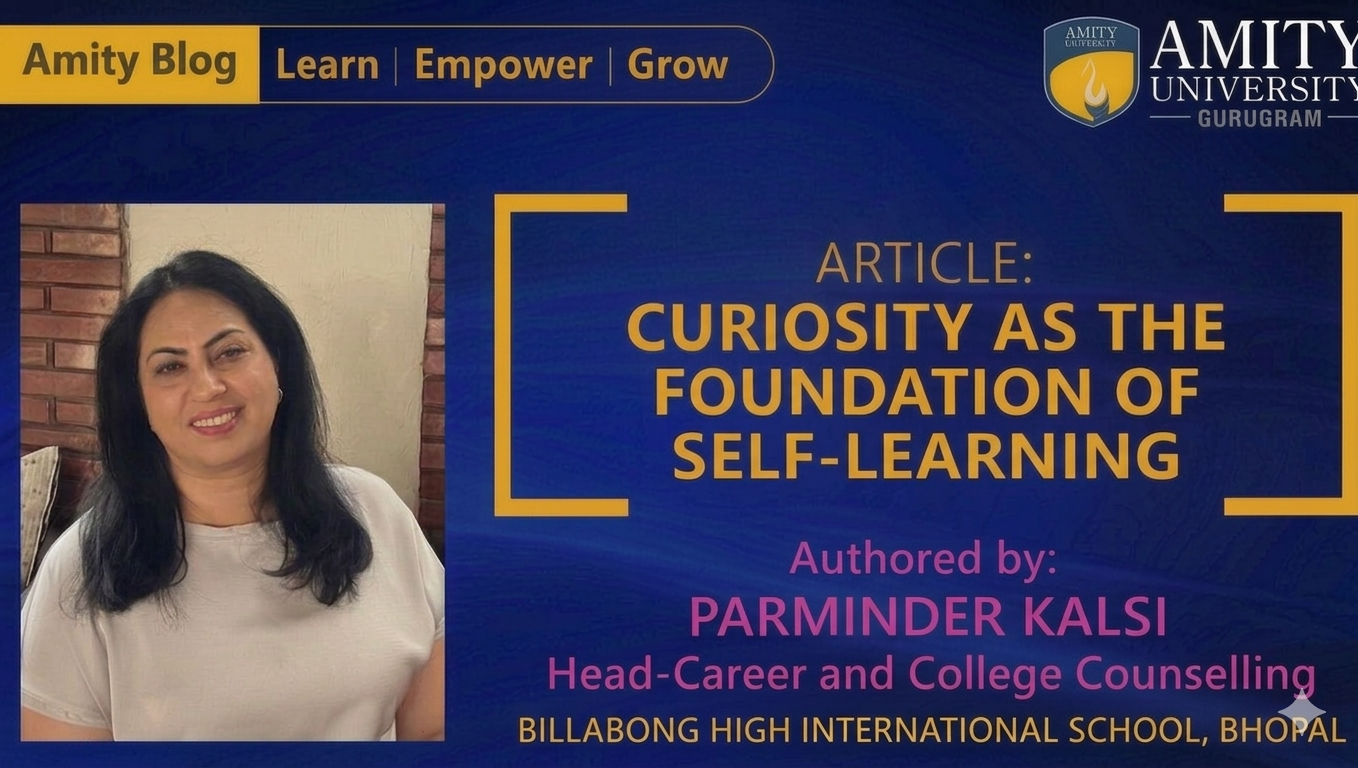
It often begins quietly with a question that refuses to leave.
A student sits through a lesson, the concept explained, the notes completed, the bell ringing as expected. Yet something lingers. Why does this work the way it does? Where does this apply beyond the textbook? While most move on to the next subject, a few carry that question home. They search, read, watch, and explore. That small, almost invisible decision to stay with the question is where real learning begins.
Curiosity is not loud. It does not demand attention. But it is deeply transformative. In a world that is constantly evolving, curiosity is no longer optional; it is a quiet edge that shapes thinkers, problem solvers, and future leaders.
Curiosity: The Starting Point of Real Learning
For years, we have associated learning with structured classrooms, syllabi, and examinations. While these systems provide direction, they are only the starting point. True understanding begins when learning becomes personal.
Curious learners do not stop at what is taught; they are drawn toward the why and how. A student intrigued by psychology may begin noticing subtle differences in how friends respond to stress or expectations. Another, interested in business, may start observing how brands influence decisions or how markets react to global events. These are not assignments; they are extensions of thought.
I once interacted with a student who, after a basic classroom discussion on climate change, began tracking local weather patterns in her own city. What started as a chapter became a personal inquiry. Months later, she was presenting her observations with a depth that no textbook alone could have offered. That is the quiet power of curiosity; it transforms information into insight.
Curiosity does not discriminate. It is not reserved for toppers or tied to a particular stream. It belongs to anyone willing to pause, question, and explore a little further.
Technology Turning Curiosity into Capability
If curiosity is the spark, technology is the amplifier.
Never before has knowledge been so accessible. A student today can learn coding from global experts, explore human behaviour through lectures, understand financial systems, or even experiment with design, all from a single device. The world has, in many ways, become a classroom without walls.
But access alone does not guarantee growth.
Two students may sit with the same resources, yet walk away with entirely different outcomes. The difference lies in intent. One scrolls, the other seeks. One consumes, the other questions.
Consider a student fascinated by automobiles. It may begin with a simple video, followed by articles, discussions, and perhaps small hands-on experiments. Over time, that curiosity evolves not just into knowledge, but into clarity of interest, even career direction. What began as a fleeting question becomes a meaningful pursuit.
Technology, therefore, is not the driver; it is the enabler. Curiosity remains the force that determines how far a student goes.
Beyond Motivation: The Power of Environment and Ownership
A common narrative among students is the need to feel motivated before beginning. But motivation is fleeting. It rises and falls, often influenced by mood, comfort, or circumstance.
What sustains learning is not motivation; it is environment.
As thoughtfully explained in Atomic Habits by James Clear, our actions are shaped less by bursts of inspiration and more from the systems we build around us. A student who creates a space for focused work, builds small daily routines, or surrounds themselves With peers who value growth is far more likely to stay consistent than one who relies purely on motivation.
I have seen this play out often. A student once shared how she struggled to feel like studying until she began dedicating just twenty minutes a day to reading beyond her syllabus. There was no dramatic shift, no sudden surge of motivation, just a simple system. Over time, those twenty minutes turned into an hour and, more importantly, into a habit. Her confidence grew not because she waited for the right feeling but because she showed up consistently.
Self-learning is not about intensity; it is about continuity.
It is about creating an environment where curiosity is not occasional but habitual.
Curiosity, when nurtured, becomes more than a trait; it becomes a way of thinking. It encourages exploration, builds independence, and prepares students for a world where answers are not always given but discovered.
For every learner, the message is simple yet profound
Stay with your questions a little longer. Explore a little deeper. Use the tools available to you, but do not wait for the perfect moment to begin. Because the ability to learn will open doors.
But the ability to learn on your own will allow you to walk through any door you choose.
Copyright © 2026 amity university | All rights reserved.