The Brave Choice: Why Asking for Help is a Counselor’s Highest Form of Strength

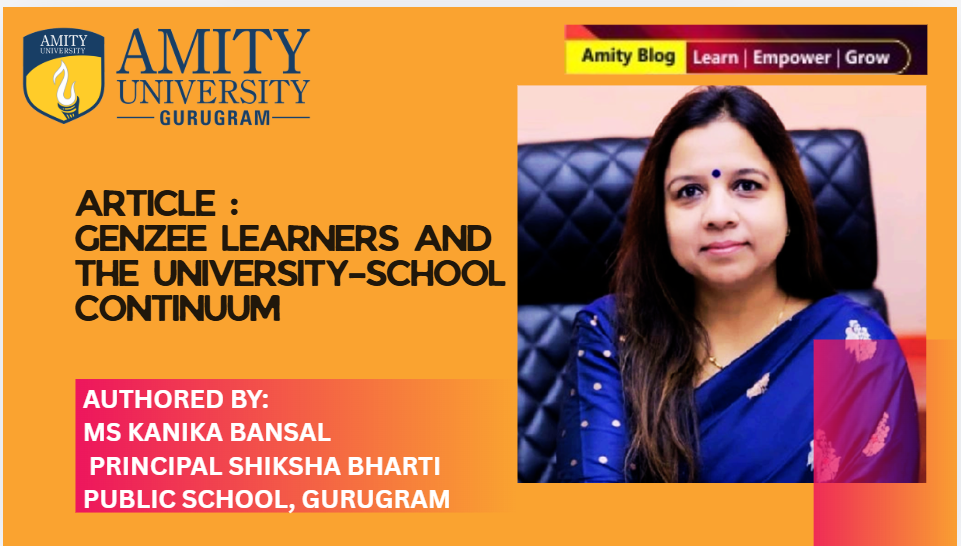
Having spent years working closely with adolescents at the senior secondary level, I often reflect on the moment when students step out of school and into university life. This transition is often described as a leap, but in reality, it should feel more like a natural progression. Education is not a set of isolated stages; it is a continuous journey. When schools and universities recognise this continuity, students are far better prepared—academically, emotionally, and socially.
Today’s learners, commonly referred to as
Generation Z, bring a distinct outlook to education. They are informed,
expressive, and deeply influenced by the digital world around them. In
classrooms, they are less willing to accept information at face value. They ask
“why,” seek relevance, and want to understand how learning connects to life
beyond textbooks. This shift has important implications for both school
education and higher education.
At the school level, the focus is on building
strong foundations. While academic rigour remains important, equal emphasis is
placed on critical thinking, communication skills, collaboration, and values.
Teachers provide structure, close guidance, and regular feedback. By the time
students complete their schooling, they develop discipline and direction.
However, the transition to university requires a new level of independence—one
that many students are still in the process of learning.
This is where universities play a crucial role in
extending what schools begin. Self-directed learning can be empowering, but it
can also feel overwhelming if introduced too abruptly. Universities that
gradually ease students into autonomy—through mentorship, inquiry-based
approaches, and project-driven learning—help them adapt with confidence. When
students feel supported while being challenged, they are more likely to take
ownership of their learning journey.
Another defining characteristic of Gen Z learners is their strong sense of purpose. Many students today are deeply concerned about social issues, environmental sustainability, and ethical responsibility. Schools encourage conversations around these themes to build awareness and empathy. At the university level, this awareness must be channelled into deeper exploration, research, and practical engagement. Exposure to real-world problems enables students to connect academic knowledge with meaningful action.
Holistic development has therefore become a shared
priority across educational spaces. Academic success alone is no longer
sufficient. Skills such as adaptability, emotional intelligence, teamwork, and
leadership are increasingly essential. Schools introduce these through
co-curricular activities, student leadership roles, and community engagement.
Universities strengthen them by offering platforms for collaboration, debate,
and experiential learning. Together, these experiences shape well-rounded individuals
prepared for life beyond formal education.
Technology also plays a central role in the Gen Z
learning experience. While students are comfortable navigating digital
platforms, comfort does not always translate into mindful use. Schools attempt
to instil balance and responsibility, while universities have the opportunity
to guide students toward purposeful and ethical engagement with technology.
When digital tools are used to support research, creativity, and collaboration,
they enhance learning rather than distract from it.
As education becomes increasingly global in outlook, students must learn to appreciate diverse perspectives while remaining grounded in strong values. Schools lay this foundation by promoting respect, inclusivity, and ethical conduct. Universities expand this understanding by exposing students to broader academic and cultural environments, helping learners develop global awareness alongside social responsibility.
Ultimately, education works best when it is viewed
as a shared responsibility. Schools prepare students with fundamental
knowledge, habits, and values, while universities refine these qualities and
prepare learners for professional and civic life. When both institutions work
in alignment, the transition becomes smoother and more meaningful.
From a school principal’s standpoint, strengthening the connection between school and university education benefits everyone—especially the learner. Gen Z students are capable, curious, and eager to contribute. What they need is continuity, guidance, and trust. When we provide that, we empower them not only to succeed, but to lead with purpose and integrity in the world ahead.

Copyright © 2026 amity university | All rights reserved.