The Brave Choice: Why Asking for Help is a Counselor’s Highest Form of Strength

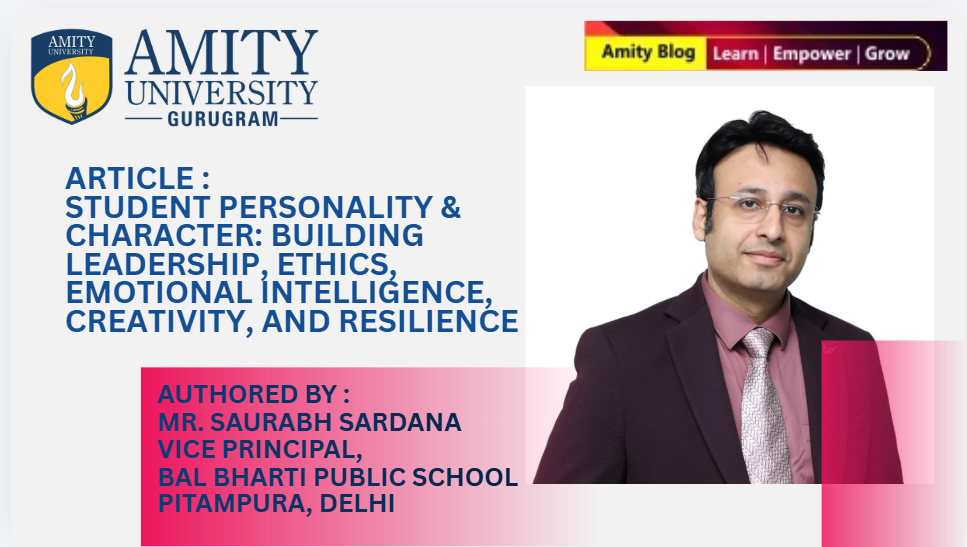
Building Leadership, Ethics,
Emotional Intelligence, Creativity, and Resilience In an era defined by rapid
change, uncertainty, and constant comparison, the true measure of education
extends far beyond academic achievement. While knowledge equips students to
earn a livelihood, personality and character empower them to lead meaningful
lives. As educators, our purpose is not merely to prepare students for
examinations, but to prepare them for life- one that demands integrity,
empathy, adaptability, and inner strength. Student personality and character
development lie at the heart of holistic education. Leadership, ethics,
emotional intelligence, creativity, and resilience are not optional traits;
they are essential life competencies. These qualities determine how students
respond to challenges, interact with others, make decisions, and ultimately
shape the world around them.
Leadership: Developing Responsibility, Not
Authority. Leadership is often misunderstood as a position of power. In
reality, leadership is a mindset—one rooted in responsibility, initiative, and
service. Every student, regardless of age or role, has the capacity to lead through
actions, choices, and attitudes. True leadership development begins when
students are encouraged to think independently, collaborate effectively, and
take ownership of their learning. Opportunities such as group projects,
student-led initiatives, debates, peer mentoring, and community engagement
allow students to practise decision-making and accountability.
Equally important is teaching ethical
leadership- where influence is guided by values, not ego. When students learn
that leadership involves listening, supporting others, and standing up for what
is right, they grow into individuals who inspire trust rather than demand
compliance. Such leaders contribute positively to organisations, communities,
and society at large. Ethics: Building a Strong Moral Compass In a competitive
world where shortcuts often appear tempting, ethical grounding becomes non
negotiable. Ethics shape character, define credibility, and sustain long-term
success. Values such as honesty, respect, fairness, empathy, and responsibility
must be consciously nurtured from a young age. Ethical education cannot be
limited to moral science lessons or rules written in handbooks.
It must be embedded in everyday
experiences- how success and failure are handled, how mistakes are addressed,
and how fairness is practised. Students learn ethics most powerfully through
observation and reflection. Engaging students in discussions around real-life
dilemmas- academic integrity, digital responsibility, social justice, and
interpersonal respect- helps them understand that ethical choices are often
complex but necessary. When students internalise values rather than follow
rules out of fear, they develop integrity that guides them even in the absence
of supervision.
Emotional Intelligence: The Foundation of Well-being and
Relationships Academic intelligence alone does not guarantee success or
happiness. Emotional intelligence- the ability to recognise, understand, and
manage emotions-is critical for personal well-being and healthy relationships.
Students today navigate academic pressure, social expectations, identity
concerns, and digital exposure, often simultaneously. Without emotional
awareness and coping strategies, these pressures can become overwhelming.
Teaching students to name their
emotions, regulate responses, practise empathy, and communicate assertively is
therefore essential. Simple practices such as reflective thinking, mindfulness
exercises, open dialogue, and collaborative problem-solving help students build
emotional resilience. When students feel heard and supported, they develop
self-confidence and emotional balance. Emotionally intelligent individuals are
better team players, effective communicators, and compassionate leaders. They
are capable of managing conflict constructively and responding to stress with
clarity rather than impulsiveness.
Creativity: Encouraging Original Thought and
Innovation Creativity is not confined to the arts; it is the ability to think
differently, ask meaningful questions, and find innovative solutions. In a world
where automation and artificial intelligence are reshaping careers, creativity
has become one of the most valuable human skills. Unfortunately, rigid systems
and fear of failure often suppress creative expression. Students may hesitate
to share ideas if they believe there is only one “correct” answer. Education
must therefore shift from rote learning to exploratory learning—where curiosity
is encouraged and mistakes are seen as part of growth.
Project-based learning,
interdisciplinary tasks, design thinking, storytelling, performing arts, and
open-ended problem-solving activities help students develop creative
confidence. When students are allowed to experiment and express themselves
freely, they learn to trust their instincts and think beyond limitations.
Creative students grow into innovators who adapt to change and contribute
original perspectives in every field they choose.
Resilience: Preparing Students for Life’s
Setbacks Life is filled with challenges, disappointments, and unexpected turns.
Resilience—the ability to recover, adapt, and grow through adversity—is perhaps
one of the most crucial traits students need. Academic setbacks, social
struggles, and personal failures are inevitable. Shielding students from
difficulty may offer temporary comfort, but it deprives them of the opportunity
to build strength.
Instead, students must be
guided to view challenges as learning experiences rather than personal defeats.
Teaching goal-setting, self-reflection, positive self-talk, and perseverance
helps students develop a growth mindset. When students understand that failure
is not a reflection of their worth but a step toward improvement, they become
more confident and determined. Resilient students learn to face uncertainty
with courage and optimism.
They develop the inner strength
required to navigate adulthood with balance and purpose. The Educator’s Role in
Character Formation Character education is not an isolated programme- it is a
continuous process shaped by daily interactions, institutional culture, and
consistent values. Teachers, school leaders, and parents together serve as role
models. Students observe far more than they are told. When adults demonstrate
fairness, empathy, discipline, and respect, students naturally internalise
these traits. A supportive environment that values effort over perfection, dialogue
over judgement, and growth over comparison fosters confident, grounded
individuals.
To Conclude Education must aim not only to create successful professionals but also responsible, compassionate human beings. Leadership, ethics, emotional intelligence, creativity, and resilience together form the backbone of strong character and balanced personality. When students are nurtured holistically, they do not merely adapt to the future—they shape it. As educators, investing in character development is not just our responsibility; it is our legacy.
***


Copyright © 2026 amity university | All rights reserved.