The Brave Choice: Why Asking for Help is a Counselor’s Highest Form of Strength

From
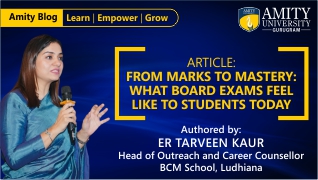
Marks to Mastery: What Board Exams Feel Like to Students
Today
Ask any Class X or XII student what board exams feel like, and you will rarely
hear words like learning or growth. You are more likely to hear pressure, fear,
expectations, or “everything depends on this.”
For many Indian students, board exams are not just assessments. They are family conversations, social comparisons, coaching centre targets, and sometimes even a measure of self-worth. A single number ends up carrying the weight of years of effort—and future dreams. Yet, the world our students are stepping into looks nothing like the one this exam system was designed for. Careers are changing fast. Skills matter more than memory. And Gen Z learners are asking a very simple question: “Why am I learning this, and how will it help me?”This is where the intent of NEP 2020 becomes deeply relevant—not as a policy document, but as a promise to students.
When Studying Becomes Surviving most students do not dislike studying. What they dislike is studying under constant fear. In the months leading up to board exams, routines shrink. Sleep reduces. Conversations revolve around “syllabus left” and “expected cut-offs.” Even high-performing students quietly worry: What if I mess up on that one day? Data from multiple child well-being studies in India show that exam years coincide with spikes in stress, anxiety, and self-doubt among adolescents. Teachers see it in classrooms.
Parents sense it at home. Students live it silently.The irony? This pressure rarely brings out a student’s best thinking. It rewards speed over depth, memory over understanding, and predictability over curiosity. NEP 2020 Is Asking a Hard but Honest Question, it challenges us to rethink a basic assumption: Does one exam truly reflect what a child knows and can do? NEP talks about: Competency-based assessment Reducing the “high-stakes” nature of board exams Giving students multiple chances to show learning Valuing application, not repetition For students, this translates into something very real: breathing space. Not the absence of exams—but the absence of fear that one exam will define them forever.
What
Students Actually want from Assessment
When students are asked what helps them learn better, their answers are surprisingly consistent: “Projects help me understand concepts better.” “When teachers explain where I went wrong, I improve.” “I wish exams tested thinking, not memorising.” Gen Z learners are not asking for easier exams. They are asking for fairer ones. They want assessments where: Understanding matters more than handwriting speed Mistakes are part of learning, not labels Creativity is recognised, not penalised In classrooms where teachers use case studies, real-life problems, debates, or research tasks, students participate more freely—and remember concepts longer. Small Changes That Make a Big Difference Reimagining board exams does not require dismantling the system overnight.
Some shifts are already making exams feel more humane:
Competency-based questions CBSE’s move towards competency-focused questions has
encouraged students to read, interpret, and apply—not just reproduce answers.
Internal assessments with meaning When projects and practical work are taken
seriously (not treated as formality marks), students feel their everyday effort
counts. Choice in questions, giving students options respects different
thinking styles and reduces panic without lowering standards.
Multiple attempts -The idea that students can improve their performance over time—rather than be judged on a single attempt—changes their relationship with learning. The Teacher’s Role Is Central No assessment reform works unless teachers feel confident and trusted. When teachers are empowered to observe progress, give feedback, and assess skills over time, classrooms become more supportive. Students ask questions without fear. Learning becomes a conversation, not a performance. But this requires training, clear guidelines, and a shift from “finishing the syllabus” to understanding the learner.
Parents Need Reassurance
Too Parents often support exam pressure not because they believe in it—but
because they fear alternatives may disadvantage their child. Transparent
assessment criteria, alignment with university admissions, and clear
communication can help parents see that deep learning is not a risk—it is an
advantage. Encouragingly, many universities are now looking beyond board marks,
using entrance tests, interviews, and aptitude-based measures.
This
signals that the system is slowly catching up with reality. Moving Forward, One
Honest Step at a Time Board exams do not need to disappear. But they do need to
evolve. If education is meant to prepare students for life, then assessment
must reflect real abilities—thinking, problem-solving, resilience, and ethical
decision-making. Marks may remain part of the system. But they should no longer
be the whole story. When exams measure mastery instead of memory, students do
not just perform better—they learn better. And that, ultimately, is what
education should feel like.
The
text highlights the evolving experience of students facing board exams,
emphasizing the intense pressure and fear associated with these assessments
rather than learning and growth. It critiques the traditional exam system for
prioritizing memorization, speed, and predictability over understanding,
creativity, and critical thinking.
Key points include:
This framework advocates a shift from exam-centric education to mastery-focused learning, aligning assessment with real-world skills and student well-being.
***


Copyright © 2026 amity university | All rights reserved.