
Gender Diversity
We are committed to promoting gender equality and inclusivity across all academic disciplines. As part of this commitment, we systematically measure and track application, acceptance, and entry rates by gender each academic cycle through our internal ERP system Amizone. This data enables us to assess our progress in fostering a diverse and inclusive student body and helps identify areas for improvement in our recruitment and admissions practices.
Our tracking process includes:
Application Rate Analysis: We monitor the percentage of applications submitted by women to each program, allowing us to understand gender representation from the earliest stages of the admissions process.
Acceptance Rate Measurement: We assess the proportion of women applicants who are accepted into their desired programs. This data helps ensure that our admissions practices support equitable opportunities for all genders.
Entry Rate Tracking: For admitted students, we also track enrollment figures to see how many women accept our offer and matriculate. Understanding this transition from acceptance to entry is crucial in helping us create a welcoming and supportive environment for all students.
Study Completion rate: At Amity University Haryana, the female study completion rate has reached an impressive 92%. This high percentage reflects the university's supportive academic environment and its commitment to empowering female students to achieve their educational goals.
The University promotes inclusivity in maintaining gender equality in all process throughout the programmes, The ratio of female vis-à-vis male students are depicted below:
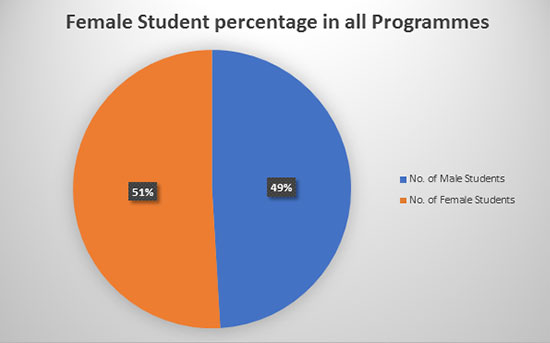
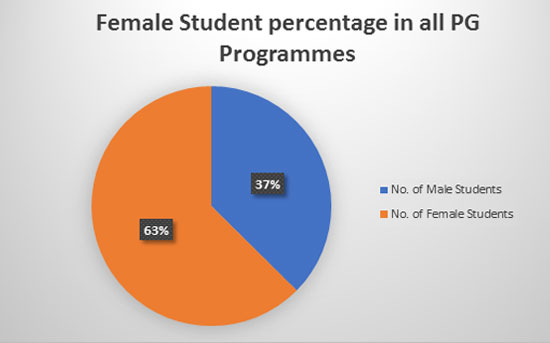
The University provides a congenial environment to all girls students and encourages them to participate in various empowering activities, the glimpse of the same is below:




Academic Year 2023-2024
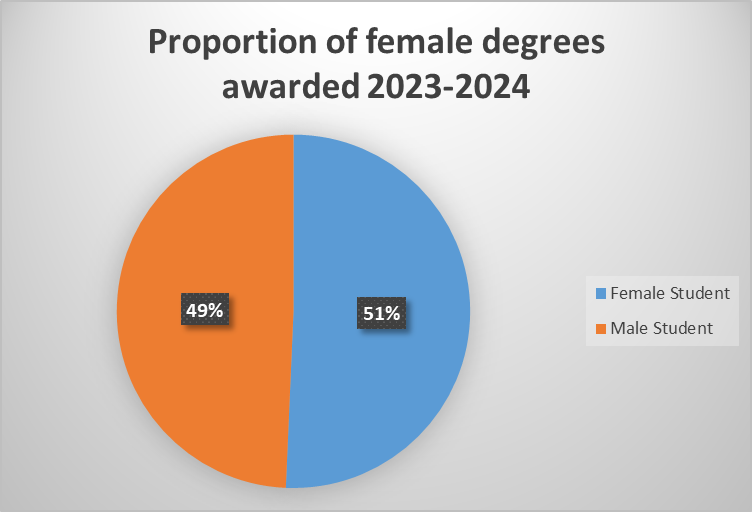
Graduation Likelihood Monitoring & Gender-Gap Mitigation Mechanism
- At the start of each academic year, the Dean Academic Officeextracts cohort-level data from the Student Information System, disaggregated by gender, programme, department, and entry year.
- Metrics include enrolment, first-year retention, year-to-year progression, credits earned, and attrition/drop-outs.
- Additional demographic indicators (e.g., rural/urban, first-generation learners) are recorded to support intersectional analysis.
- For every cohort, the Dean Academic Office calculates the graduation likelihoodfor women and men separately, based on historical completion patterns.
- A Gender Graduation Equity Index (GGEI)is
computed:
GGEI = (Women’s graduation likelihood ÷ Men’s graduation likelihood) × 100. - Dashboards showing trends are reviewed annually by the Diversity & Inclusion Committee.
- The student lifecycle platform automatically flags women students showing academic risk (e.g., inadequate credit completion, significant GPA drop).
- The Dean Academic Office issues quarterly reports for counselling and intervention follow-up.
- Mentorship Programme:Women students are paired with faculty and alumni mentors for academic and career guidance.
- Academic Support Workshops:Departments offer focused sessions, especially for women in STEM and professional programmes.
- Peer Support Circles:Women-led study groups promote retention and confidence.
- Financial & Resource Assistance:Fee waivers, grants, and resource support are made available for women facing financial barriers.
- Flexible Learning Options:Hybrid learning, special tutorials, and structured re-entry plans help women balance academics with personal responsibilities.
- The Diversity & Inclusion Committee reviews GGEI values, progression rates, and intervention outcomes annually.
- If gaps are detected within specific sub-groups, a targeted Action Plan is created and implemented.
- AUH publishes an annual summary of gender-disaggregated graduation and progression data along with actions taken.
Baseline Data Collection
Graduation Likelihood Analytics
Early Warning and Flagging System
Targeted Schemes to Close the Gap
Monitoring, Review & Continuous Improvement
Transparency & Public Reporting
This ensures accountability and supports continuous improvement in promoting gender equity in graduation outcomes.
© 2021 Amity University Gurugram. All Rights Reserved.