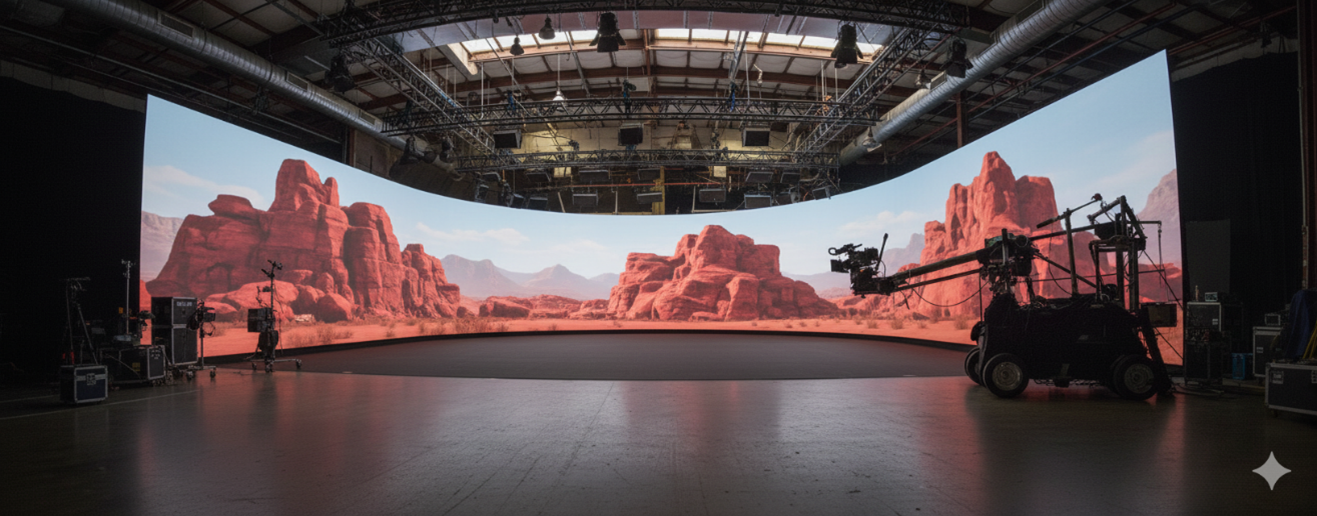
Virtual Production & Unreal Engine

By Mr Jeet Bhatia, Teaching Associate, Amity School of Communication, Amity University Gurugram
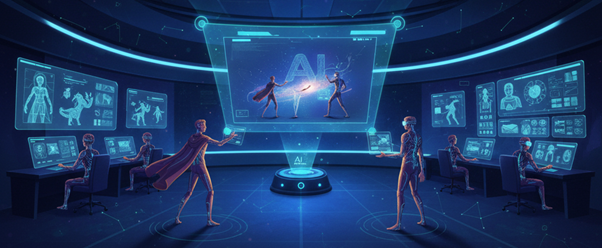
Introduction: AI-assisted animation is also revolutionizing the creation of animated content. AI-assisted animation uses AI that helps animators be more efficient, intelligent, and creative in their animation projects. In the Traditional animation technique whether 2D or 3D animators had the responsibility of animating the action, frames, rigging the characters, and detailing the animation. All this used to take quite long even in the creation of short scenes. AI does not substitute animators; rather, it is an array of applications which essentially reduces the repetitive steps involved in the process, giving more time to animators to work on the content. The advent of 2D animation has assisted in the process of “in-battening animation.” The animators are required to create essential poses from the beginning to the end movements, whereas the AI "also generates the frames in-between."
This process significantly enhances the speed of animation, primarily in the process of the “walk cycles,” which are needed in dialogue scenes. The "frame interpolation" or "slow-motion" process with more details can be done with the use of AI.
These tools allow for better new interns and professionals to produce fluid 2D animation without frames. The involvement of AI is more significant in Marker less motion video clips. AI tools can easily analyse the body, face, and body parts. After setting up the tools inside a 3D rig, AI can analyze the problems of sliding feet, jitter, unnatural curves, and balance problems to automatically clean them up. Tools such as AI physics animation understand the concepts of gravity, mass, and motion path, which give more realistic output in comparison to other procedural automation tools. What are your views regarding all these developments in animation tools?
Rigging with AI:
AI is revolutionary rigging, which is one of the complex aspects of 3D animation. Auto-riggings have increased the ability to skeletonize and skin a character in a matter of minutes, which took years of skills and literally months of manual keyframing. Facial animation and AI-controlled lip-syncs have become commonplace. AI analyzes voices to match them with utterances accurately, with support for all languages. Games, presentation software, or real-time engines such as Unreal can benefit from AI facial animation, which can run without lag while the actual recording is being done.
Animations by AI is an important role of iterations. Artists and directors can quickly preview movements or change the prompts and recreate performance without restarting the entire process. It is very beneficial for filmmakers, students, and small production studios. It is an aspect that the role of the human factor in storytelling, personality, short design, and so on is not an algorithm.
Motion capture style video:
Technology is what completely changed the whole game. motions of people or objects are replayed by the miraculous technology Motion capture, or MoCap. It captures the motions of the actor using some sensors placed on a person's body. This data is subsequently translated into digital form, which helps the animators in developing realistic characters for films and video games. Currently, fantastic graphics for films become very easy for animators using a motion capture machine. In this context, in films such as "Avatar," actors wear a special suit consisting of some markers which record all their actions.
How to AI work:
The animation can be created in two ways: first, text to animation, and second, picture to animation. You can upload any action video and select an avtar. In just one click, AI transforms it into an animated 3D or 2D video. Several creative changes involve hair style, clothes, gender, figure size, and movement anytime. We are also able to use voiceover and deluge, too. We can put facial expression and put more than 16 languages. At any moment, there is always hope for customization; you can change anything at any time at any stage. We can create a sequence, make a short video, and a short film also.
Motion capture for gaming word:
In the gaming market, motion capture technology is a game changer. It makes character actions in a game more realistic, and players can easily relate to the game. Developers can use MoCap technology to create characters in a game in a natural and appealing manner. Today, motion capture technology is applicable in sports science. It helps in understanding the movements of athletes. Thereby, it improves their performance and prevents injuries.MoCap technology combines technology and creativity. It has changed the method in which a story is told.
They also have a 3D video editor that you can easily access using your online browser and which you don’t need any coding, programming, or animation skills for. You can switch camera shot types, add voice-overs, design your own Avatar cartoon character, and also make videos using the generative AI.
Generative art:
“Generative art is the embodiment of the idea as a process, rather than as a physical object or an event, transferring the creative process from the real world to the digital domain and, more recently, into the realm of algorithms. It contributes to the creation of a dynamic intersection between the natural and the artificial environments.
Just as the DNA structure generates novel and unpredictable events through algorithms and transformation rules, so too do generative algorithms and transformation rules yield novel and unpredicted sequences of events such as artistic works, industrial designs, architectural designs, music, and communications systems characterized by distinct generative concepts. Generative art is considered an edge technique in design creativity because it exemplifies the increasing naturalness of the world of the artificial. By generative projects, morphogenetic design, and evolutionary systems, the identity and evolution of novel events may be envisioned so as to improve the complexities of present spaces and interactions.
***********************************
What next?
Skills Required to be a Good Journalism & Mass Communication
· Effective Communication Skills
· Strong Writing & Editing
· Clarity and Conciseness
· Research & Analytical Skills
· Good Vocabulary
· Digital & Technical Skills
· Good Vocabulary
Career Opportunities in Journalism & Mass Communication
· Journalist / Reporter
· Public Relations (PR)
· News Anchor
· Radio Jockey (RJ)
· TV / Film Producer
· Photojournalist
Relevant Courses in Journalism & Mass Communication
· B.A. (Film, TV & OTT Production) (Honours/Honours with Research)
· B.A. (Journalism & Mass Communication) (Honours/Honours with Research)
· B.A. (Journalism & Mass Communication) - 3 Continent
· B.A. (Journalism & Mass Communication) - International
· B.Sc. (Animation & Visual Graphics) (Honours/Honours with Research)
· Doctor of Philosophy (Journalism & Mass Communications)
· Doctor of Philosophy (Journalism & Mass Communications) - Part Time
· M.A. (Journalism & Mass Communication)
· PG Diploma in Journalism & Mass Communication
************************
Copyright © 2026 amity university | All rights reserved.