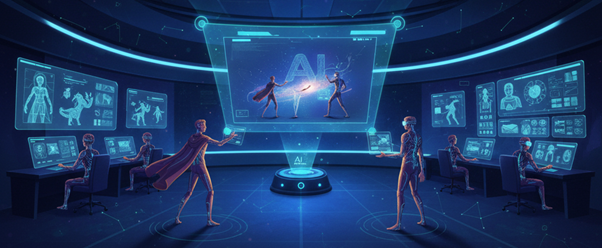
Virtual Production & Unreal Engine

By Mr Jeet Bhatia, Teaching Associate, Amity School of Communication, Amity University Gurugram
Introduction: Cinema has always been a marriage of art and technology. From the invention of the motion picture camera to the rise of computer-generated imagery (CGI), filmmakers have constantly sought new ways to tell stories more vividly. Today, the industry is experiencing another revolution: virtual production. Unlike traditional filmmaking, where actors perform against green screens and visual effects are added months later, virtual production integrates digital environments live on set. Directors, actors, and crew can see the final scene instantly, blending physical and digital worlds seamlessly. This innovation is already shaping blockbuster films, streaming series, commercials, and music videos, with productions like The Mandalorian, Avatar sequels, and Marvel movies leading the way.
How Virtual Production Works:
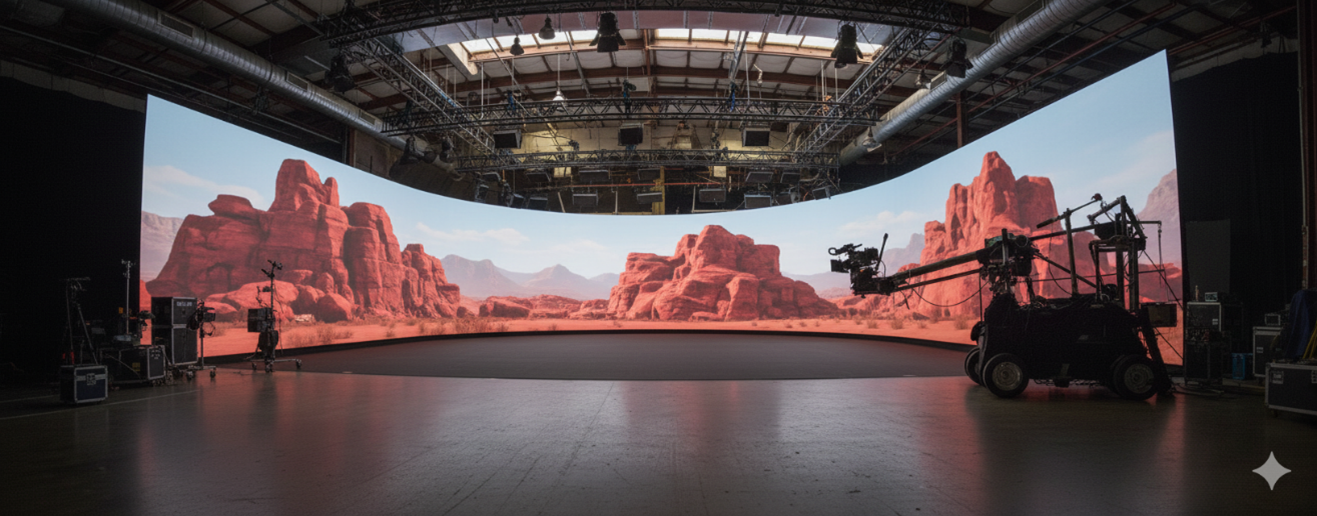
At its core, virtual production combines LED walls, game engines, and camera tracking to create immersive environments.
LED Walls:
LED walls are massive digital screens built from modular panels. Each panel contains thousands of LED bulbs that glow in different colors and brightness levels to display high resolution visuals. These walls can be flat, curved, or even circular, surrounding the set with panoramic backgrounds. When used in filmmaking, LED walls display real time 3D environments, space, jungles, futuristic cities, generated by game engines such as Unreal Engine or Unity. As the camera moves, sensors track its position so the background shifts naturally, producing realistic depth and parallax. Actors benefit enormously. Instead of imagining a scene in front of a green screen, they can see the environment with their own eyes. The LED walls also cast natural light and reflections on actors and props, making the visuals more convincing.
Simulcam:
Another breakthrough tool is Simulcam, which links real cameras with 3D software engines. It allows filmmakers to combine live footage with digital environments during shooting. CGI characters or objects can be visualized alongside actors, improving timing, interaction, and creativity. For example, a spaceship or monster can appear on the monitor in real time, helping actors react naturally.
Rotating Stages:
Rotating stages are circular platforms that spin 360°. They enable filmmakers to capture subjects from all angles without moving cameras or lights. This is especially useful for product shoots, fashion, and motion‑tracked sequences in extended reality (XR) or LED volume stages. By ensuring consistent visuals, rotating stages save time and improve quality.
Advantages of Virtual Production:
Virtual production offers several clear benefits:
Ø Realistic Lighting: LED walls naturally cast light and reflections on actors and props.
Ø Reduced Post‑Production Costs: Eliminates extensive VFX work compared to green screen workflows.
Ø Flexible Locations: Filmmakers can switch from a desert to Iceland within minutes, saving travel and logistics costs.
Ø Creative Freedom: Directors can adjust backgrounds, lighting, and camera angles instantly.
Ø Efficiency: Faster shooting schedules and fewer reshoots.
Ø Safety: Dangerous or inaccessible locations can be recreated virtually.
As ILM producer Marisa Gomez put it, “You can switch to the Iceland location to the desert location all within the same day shooting.”
Historical Evolution:
Virtual production did not appear overnight. Its roots lie in projection techniques used throughout the 20th century.
Rear Projection and Blue Screens:
Classic films like North by Northwest used rear projection, where pre-recorded footage was projected behind actors. Later, blue and green screens became standard, though they often caused unwanted colour spill on talented
Early Experiments:
By 2013, films such as Gravity experimented with LED boxes to project realistic lighting. Cinematographer Emmanuel Lubezki designed a 20-foot cube of LED screens to simulate spacecraft interiors and Earth’s rotation. Though the resolution was low, the lighting on the actors’ faces was authentic. Around the same time, House of Cards used LED screens to project moving street plates during driving scenes, creating realistic reflections in car windows. Oblivion employed large-scale projections of sky backgrounds, while Train to Busan and Murder on the Orient Express used LED walls for moving scenery.
On Rogue One, curved LED screens displayed hyperspace effects, providing both interactive lighting and in-camera VFX. Director Jon Favreau later pushed the technology further with The Jungle Book and The Lion King, using game engines to drive virtual cameras. The true breakthrough came with The Mandalorian (2019). Using Unreal Engine, filmmakers created real-time rendered, photo-realistic environments displayed on LED volumes. Cinematographer Greig Fraser described it as “the closest thing to playing God that a DP can ever do—you can move the sun wherever you want.” Since then, productions like The Batman, The Midnight Sky, and Star Trek: Strange New Worlds have embraced LED volumes, proving virtual production’s growing dominance.
Applications Beyond Film:
Virtual production is not limited to cinema. It is increasingly used in:
Ø Commercials: Brands can showcase products in exotic locations without travel.
Ø Music Videos: Artists perform against dynamic, immersive backgrounds.
Ø Live Events: Concerts and sports arenas use LED walls for dramatic visuals.
Ø Advertising: Malls and exhibitions employ LED screens for interactive displays.
Ø Television: Studios use LED volumes for driving scenes, talk shows, and immersive storytelling.
Flexible Locations and Creative Freedom:
One of the most transformative aspects of virtual production is location flexibility. Traditionally, filmmakers had to travel, secure permits, build sets, and manage weather. Virtual production eliminates these hurdles. Digital backgrounds shown on LED walls, called LED volumes, look realistic on camera. Software like Unreal Engine generates these environments instantly. When the camera moves, the background shifts correctly, creating natural depth. This means filmmakers can shoot multiple locations in a single day without moving the crew. Dangerous or inaccessible places, volcanoes, war zones, outer space, can be recreated safely in a studio.
The Beginner’s Advantage:
Interestingly, virtual production is still in its early stages, and even experienced filmmakers are learning as they go. This creates a unique situation where the gap between beginners and experts is surprisingly small. People who start learning virtual production now can grow quickly if they stay focused and practice. With dedication and curiosity, beginners can reach advanced levels in a short time. Passion and learning speed matter more than years of experience, making this an exciting time for new talent.
Future Outlook:
Virtual production is evolving rapidly. As LED technology improves, resolutions will become sharper, color's richer, and costs lower. Game engines are advancing too, offering more realistic physics, lighting, and rendering.
The future may bring:
Ø Hybrid Sets: Combining physical props with digital environments seamlessly.
Ø AI‑Driven Environments: Automatically generating realistic worlds based on scripts.
Ø Interactive Storytelling: Allowing directors to adjust environments dynamically during performances.
Ø Expanded Accessibility: Smaller studios and independent filmmakers are adopting affordable virtual production setups.
Ultimately, virtual production is set to become the new industry standard, reshaping how stories are told across film, television, advertising, and live entertainment.
Conclusion:
Virtual production represents the perfect blend of art and technology. By merging real and digital worlds in real time, it offers filmmakers unprecedented flexibility, efficiency, and creativity. From LED walls to simulcam and rotating stages, this innovation is reshaping the future of storytelling. As the industry continues to evolve, one thing is clear: virtual production is not just a tool; it is a new way of imagining cinema. For filmmakers, students, and enthusiasts, now is the time to embrace this revolution and explore the limitless possibilities it offers.
*********************
What next?
Skills Required to be a Good Journalism & Mass Communication
· Effective Communication Skills
· Strong Writing & Editing
· Clarity and Conciseness
· Research & Analytical Skills
· Good Vocabulary
· Digital & Technical Skills
· Good Vocabulary
Career Opportunities in Journalism & Mass Communication
· Journalist / Reporter
· Public Relations (PR)
· News Anchor
· Radio Jockey (RJ)
· TV / Film Producer
· Photojournalist
Relevant Courses in Journalism & Mass Communication
· B.A. (Film, TV & OTT Production) (Honours/Honours with Research)
· B.A. (Journalism & Mass Communication) (Honours/Honours with Research)
· B.A. (Journalism & Mass Communication) - 3 Continent
· B.A. (Journalism & Mass Communication) - International
· B.Sc. (Animation & Visual Graphics) (Honours/Honours with Research)
· Doctor of Philosophy (Journalism & Mass Communications)
· Doctor of Philosophy (Journalism & Mass Communications) - Part Time
· M.A. (Journalism & Mass Communication)
· PG Diploma in Journalism & Mass Communication
************************
Copyright © 2026 amity university | All rights reserved.