
AI Technology & Future Skills

By Subrata Pal, Director & Head, Amity School of Ocean-Atmospheric Science and Technology (ACOAST), Amity University, Gurugram
Introduction: During recent years, the subject of environmental monitoring has been drawing worldwide attention. There is a growing body of observational, theoretical and modelling evidence which suggests that atmospheric aerosols and trace gases play vital role not only in the thermal state of the Earth-atmosphere system but also in the local / regional air pollution. The potential effects of increased human activities such as industrialization, fossil fuel combustion, biomass burning and de-forestation on the Earth’s atmospheric environment, biological ecology as well as on material and property have started causing grave concern in knowledgeable quarters. Moreover, the closely packed houses, streets and industrial complexes, with scarce open spaces, hamper the natural meteorological processes of dispersion and dilution of the high concentrations of pollutants as they are released from the sources into the atmosphere. All these effects have prompted numerous efforts to develop a variety of experimental techniques and systems for regular monitoring of various environmental parameters. Much of the impetus of the work has been simulated by the conspicuous presence and observed impact of anthropogenic emissions associated with many urban environments where a general build-up of aerosols over large geographical areas has been realized mainly due to human activities. These pollutants constitute a threat to public health both directly through inhalation and indirectly through possible long-term influences on the atmospheric environment. Efficient methods for the measurement of environmental pollution are of great interest in any Programme for air quality assessment, control and forecast.
Compared to direct measuring techniques which provide reasonably reliable information at a specific location, more representative values can be obtained with remote sensing techniques. Of the latest optical remote sensing techniques, laser radar (lidar) has been recognized to be a powerful and versatile tool for environmental monitoring. Different lidar techniques that are available for quantitative determination of air pollutants such as aerosols, minor and trace gases are summarized in this article.
The field of optical remote sensing was greatly advanced by the laser, which offers several improvements over conventional light sources. These include narrow spectral width (< 0.01 m), a frequency or color that is often tunable, and high peak power (> 106 W) available
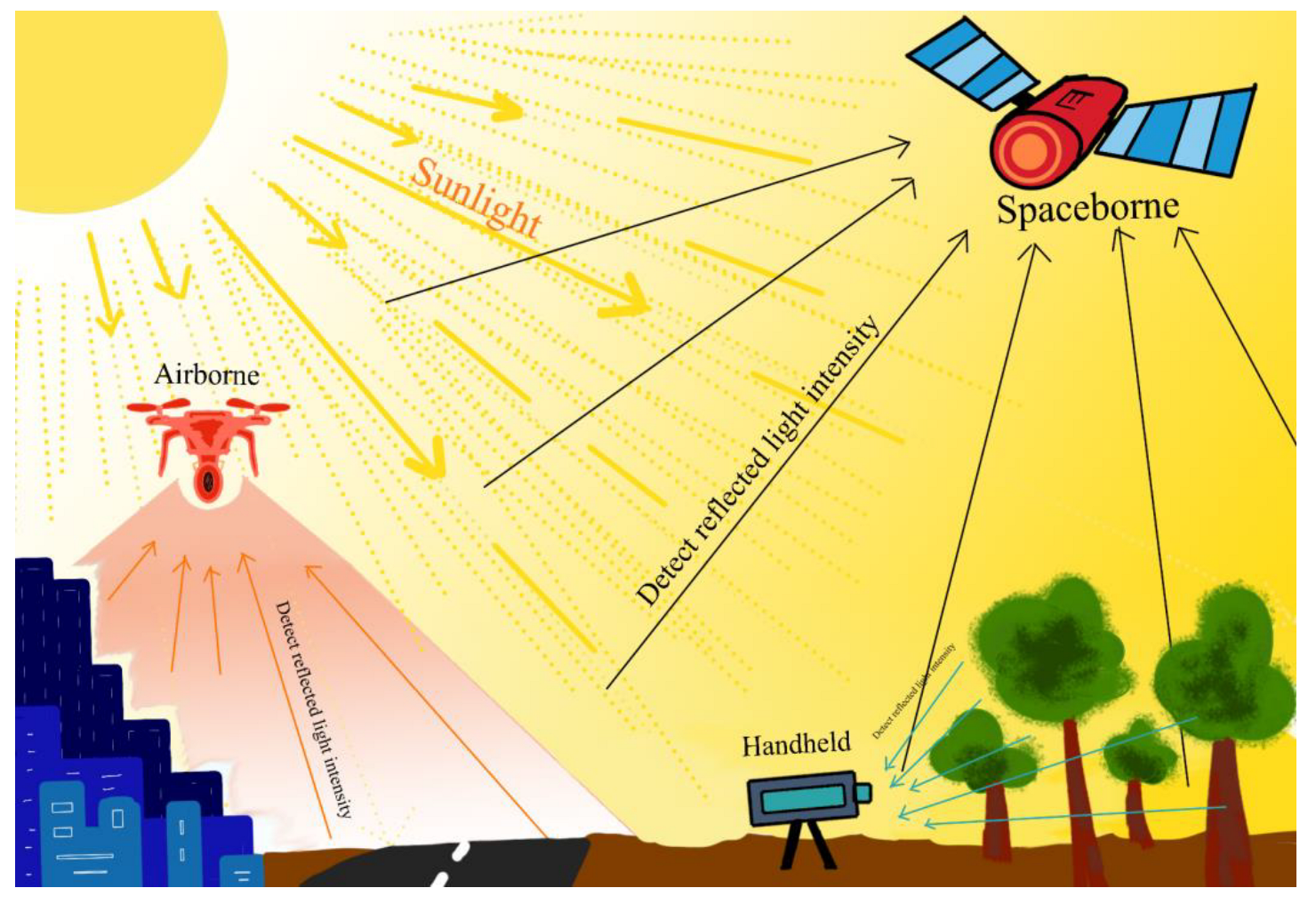
in short pulse (<1 sec) and in a narrow beam (< 10 cm in dia.). The discovery of different laser sources in the past decade, coupled with improvements in optical instrumentation and data processing, has been responsible for the recent surge in the number of laser remote sensing systems. This improved capability has been accompanied by an increased awareness of the need to monitor the impact of natural and anthropogenic influences on the environment. Laser remote sensing for environmental monitoring can be accomplished basically in two ways. One technique involves measurement of long-path absorption employing a tunable laser source and detector are located together and a retroreflector is placed at a distance of several hundred meters, such a system is useful when the laser source is weak, since the retroreflector greatly enhances the returned radiation. In another technique, the laser and the detector are located together and no retro-reflector is used as the target, in this case the returned laser radiation is due to backscatter from aerosols in the atmosphere (in the case of vertical profiling of pollutant concentration) or a topographic target such as a hill or trees (in the case of path-averaged measurements of pollutant levels).
In the lidar technique, radiation/energy is transmitted into the atmosphere, some portion of the light is absorbed and / or scattered back into the laser direction, where a telescope with a photodetector (receiver) produces an electrical signal proportional to the returned intensity. The intensity of the signal indicates the concentration of absorbing or scattering material. The primary influence of the atmosphere on a low-power laser beam is through scattering and absorption. Both processes cause an attenuation of the beam according to Bouguer’s or Beer’s law as I = I0 e-R, where I is the intensity of the laser beam after transmission over a distance R; is the atmospheric extinction coefficient; and I0 is the initial intensity of the beam. It is possible to express as a sum of terms
= Mie + Ray + Raman + abs
where Mie, Ray and Raman are the extinction coefficients related to Mie, Rayleigh and Raman scattering, respectively and abs is the molecular absorption coefficient. Lidar systems have now reached the stage where they can be used not only by scientists and engineers at Universities and Research Organizations, but also for routine pollution monitoring by officials involving in environmental control. Basically, these systems can be operated either in monostatic configuration or in bistatic configuration. Monostatic systems offer portability for their operation from different experimental platforms while bistatic systems possess unique advantages for certain applications. By employing either of these configurations, different kinds of lidars are used depending on the type of environmental studied.
A block diagram below presents different lidar techniques that are commonly used for monitoring aerosols, air molecules and gases in the near Earth’s environment. Mie scattering is associated with larger particles such as aerosols whose size is on the order of probing laser wavelength.
Rayleigh scattering is due to particles in the atmosphere, such as molecules or fine dust, that are much smaller than. Rayleigh and Mie processes are elastic scattering in which the scattered light is the same wavelength (or color) as the incident laser beam. Raman scattering is associated with interaction of the laser beam involving excitation of the energy levels of a molecule and re-radiation at a different wavelength. Absorption of the laser beam is a resonant interaction (direct absorption) leading to excitation of the molecule, followed possibly by fluorescence. Thus, the Raman and fluorescence processes are in-elastic scattering in which the wavelength of scattered and that of the laser are different. The DIAL (Differential Absorption Lidar) or DASE (Differential Absorption Scattering Energy) measures the concentration of molecular species in the atmosphere by transmitting two wavelengths, only one of which is absorbed, and detecting the difference in the intensity of the returns at the two wavelengths, the backscattering in the DIAL may be from a hard target or aerosols. Fluorescence lidar uses two wavelengths as in a DIAL system and in addition uses spectrometric techniques to separate the wavelength-shifted fluorescence signal from the strong Rayleigh backscatter in the atmosphere. Raman lidar uses a single wavelength laser and sophisticated spectrometric detection techniques to spectrally resolve the wavelength-shifted signal from the strong background due to Rayleigh or Mie scattering.

Block diagram showing different types of LIDAR techniques for Environmental Monitoring and Protection
The salient applications of lasers for remote sensing of environmental pollution are summarized. The trade-offs involved in atmospheric aerosols from the point of view of health risk pose a potentially significant dilemma to decision makers to choose a pathway for minimizing environmental risk from atmospheric pollution. Because of high sensitivity and resolving power, laser-based systems have particular advantage as they can be used for the study of both minor or trace and major pollutants while other remote sensing systems are useful only when the concentration levels of pollutants exceed certain limits. In the light of rapid growth in anthropogenic activities, particularly over urban areas, regular monitoring of aerosol and gaseous pollutants over longer periods is essential for proper planning of environmental protection activities. In this context, either systems with single laser source and multiple receivers spreading over larger area or portable laser radar systems for multi-dimensional mapping of pollutant characteristics are suggested to meet the future requirements / planning of environmental monitoring / protection.
Acknowledgements: The author expresses sincere gratitude to Hon’ble Founder President Sir, Hon’ble Chancellor Sir, Hon’ble Vice Chancellor Sir and Hon’ble Pro Vice Chancellor Sir, Amity University Haryana (AUH), Gurugram, for continued motivation and support.
***************
Let's understand more:
Skills required to be good in
****************
Copyright © 2026 amity university | All rights reserved.