10 Jul 2026|Noida | Amity University, Noida
Pharmacy Council of India highlights the Roadmap for Implementing New Undergraduate Pharmacy Curriculum (2026) at Amity University
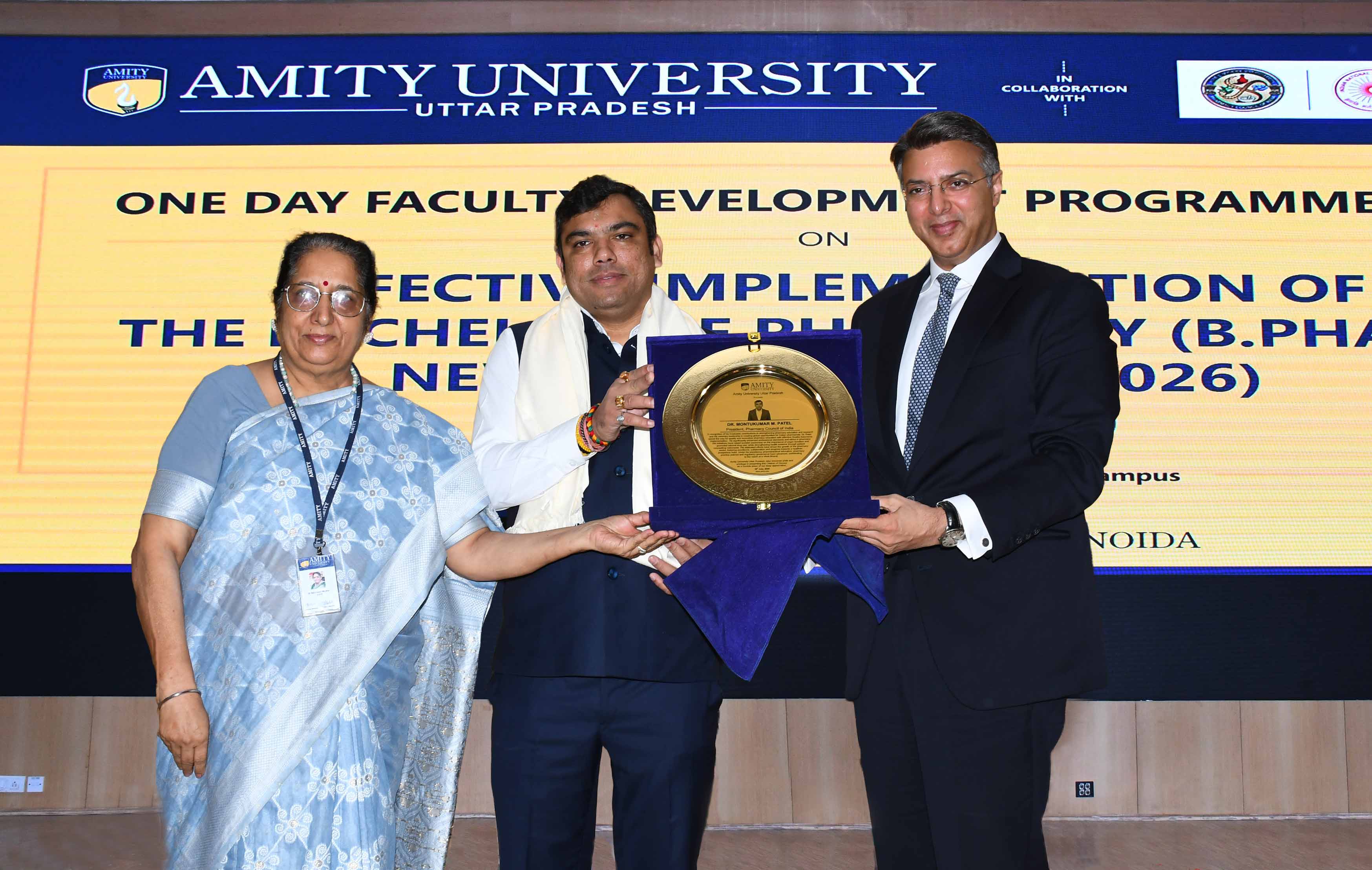
Amity Institute of Pharmacy, Amity University Uttar Pradesh (AUUP), organized a one-day Faculty Development Programme (FDP) on "Effective Implementation of the Bachelor of Pharmacy (B. Pharm) Curriculum (2026) under NEP 2020". The programme aimed to equip faculty members with a comprehensive understanding of the revised B. Pharm Curriculum (2026), its alignment with the National Credit Framework (NCrF), National Skills Qualifications Framework (NSQF), evolving standards in pharmacy education, thereby strengthening Outcome-Based Education (OBE), competency-based curriculum design, learner-centric pedagogies, innovative assessment practices, and effective curriculum implementation. The programme witnessed participation by 120 participants representing institutions such as GD Goenka College of Pharmacy, Jamia Hamdard, Hindu College of Pharmacy, Subharti College of Pharmacy, K.N. Modi Institute of Pharmaceutical Education and Research, and several other institutions.
Speaking about the revolutionary changes reshaping pharmacy education, Chief Guest, Dr. Montukumar M. Patel, President, Pharmacy Council of India (PCI), New Delhi, said, "The new curriculum has been designed to ensure uniform implementation across all pharmacy institutions while aligning with the objectives of the National Education Policy (NEP) 2020. The skill and outcome-based curriculum incorporates emerging domains such as artificial intelligence, medical devices, digital healthcare and other contemporary advancements that are transforming the pharmacy sector. To facilitate seamless implementation of the new curriculum, the Pharmacy Council of India is conducting Faculty Development Programmes across the country so that institutions are fully prepared to adopt the revised curriculum from this academic session itself.”
Emphasizing upon tech-driven initiatives, he further added, “Pharmacy Council has introduced technology-driven reforms including biometric attendance systems for faculty members to ensure greater academic accountability. The Council also conducted a drone-survey of all pharmacy colleges in India. In addition, the Council is launching a new digital portal including IT-enabled solutions to simplify academic and regulatory processes, improve transparency and strengthen institutional governance. The Council has also extended financial support to GPAT-qualified scholars (Graduate Pharmacy Aptitude Test) to foster research and academic excellence.”
“Recognising the importance of global exposure, the Pharmacy Council of India has been actively engaging with international counterparts to remove academic barriers, promote student exchange programmes and create opportunities for students to gain global perspectives and industry exposure. Faculty Development Programmes have been organized at over 25 locations across the country, benefiting nearly 12,000 teachers and students. Pharmacy is a multidisciplinary profession that demands close collaboration between academia and industry. Active participation of faculty members and students is essential to bridge the gap between classroom learning and industry expectations. To further enhance employability, Pharmacy Council of India recently organised a Job Fair in Gujarat to connect pharmacy graduates with leading employers, thereby generating job opportunities and will continue to take job fairs to other parts of the country including South India, Northeast and western regions.” , said Dr. Patel. He called upon the institutions to encourage the students to start their own ventures and contribute to the growth of the economy.
Highlighting the pivotal role of educators in shaping future-ready healthcare professionals, Dr. Atul Chauhan, Chancellor, Amity University Uttar Pradesh, stated, "The transformative reforms introduced under the exemplary leadership of Dr. Montukumar M. Patel have significantly strengthened pharmacy education by making it more contemporary, skill-oriented, industry-aligned and outcome-driven. The vision of Viksit Bharat 2047 can be realised only by nurturing and empowering the youth of the country. Therefore, Higher Education Institutions have a profound responsibility to create an ecosystem that foster academic excellence, research, entrepreneurship and innovation, enabling the students to become inspiring future leaders. The role of teachers in shaping the students is crucial Beyond imparting knowledge, they have the responsibility of igniting curiosity, encouraging critical thinking, nurturing creativity and instilling strong ethical values among students. By inspiring young minds to explore, innovate and lead with purpose, educators can prepare the next generation of pharmacy professionals to address global healthcare challenges, contribute to scientific advancements and play a meaningful role in building a healthier, self-reliant and developed India."
Stressing upon the significance of implementing the New B. Pharm Curriculum, Prof. (Dr.) Balvinder Shukla, Vice Chancellor, Amity University Uttar Pradesh, stated, "The successful implementation of the revised B. Pharm Curriculum requires faculty members to embrace emerging pedagogical approaches, outcome-based curriculum design, competency-based assessment and learner-centric teaching methodologies. The FDP provides an important platform for strengthening academic capacity while promoting experiential learning, digital technologies, artificial intelligence and continuous quality enhancement, thereby preparing future-ready pharmacy graduates to meet the dynamic needs of the healthcare and pharmaceutical sectors, in line with NEP 2020."
The Faculty Development Programme included a series of expert-led technical sessions on key themes including “Industry-Academia Synergy”, “Need for NEP 2020: Transforming Pharmacy Education”, “Outcome-Based Education”, “Overview of the B. Pharm Curriculum (2026)”, “Assessment and Evaluation Framework”, competency-based teaching methodologies, curriculum implementation strategies, and “Emerging Trends in Pharmaceutical Education”.