03 Sep 2026|Noida | Amity University, Noida
Renowned Psychoanalyst Dr. Salman Akhtar Delivers an Insightful Lecture on “Seven Types of Truth and Their Clinical Relevance” at Amity
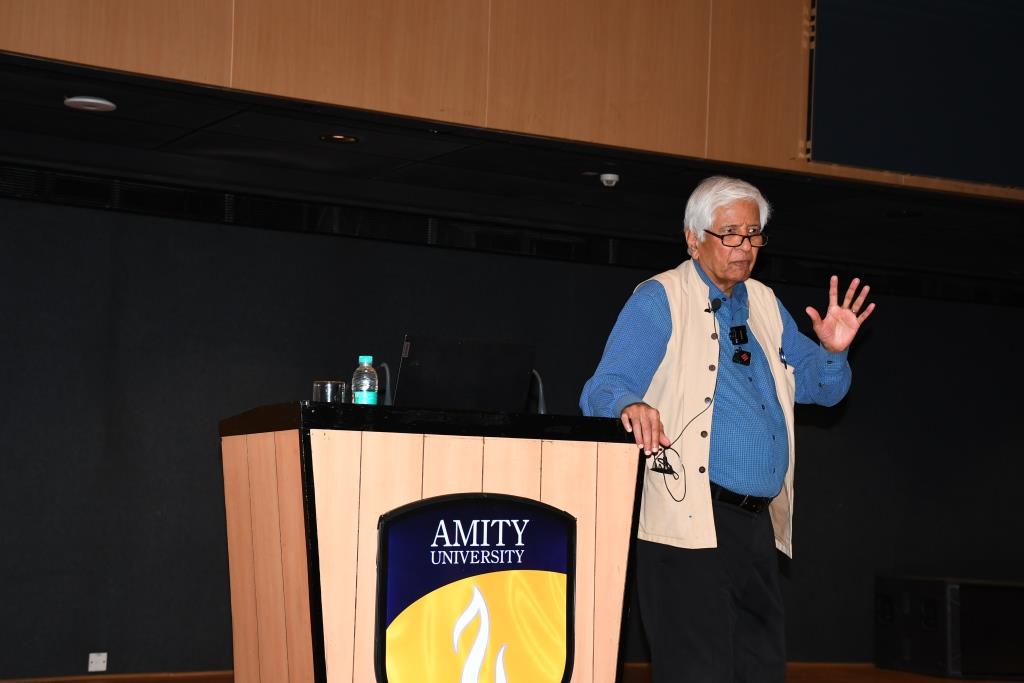
Amity Institute of Behavioural Health & Allied Sciences organized a Guest Lecture by Dr. Salman Akhtar – Psychoanalyst; Professor of Psychiatry & Human Behavior at Jefferson Medical College and Jefferson University Hospital, Philadelphia, on the topic "Seven Types of Truth and their Clinical Relevance". Different forms of truth can influence how individuals remember events, construct narratives, interpret experiences and derive meaning from their lives. Understanding these distinctions can foster greater empathy, improve clinical listening, providing a valuable framework for understanding how memory, emotions, perceptions and personal experiences shape human behaviour, for psychology students and practitioners.
Delivering the Guest Lecture, Dr. Akhtar explained that there are Seven Types of Truth. “Physical Truth, although seemingly simple and objective, is not always straightforward, as the way an event is perceived and interpreted can influence an individual’s understanding of reality. He further explained that Historical Truth relates to events of the past but may not always be completely reliable, as human memory is selective and can be influenced by subsequent experiences, emotions and personal interpretations. In the context of psychology, understanding this distinction is particularly important while exploring an individual’s memories and experiences, where subjective recollection may differ from objective events. Narrative Truth is something we agree upon, it is reasonable, plausible and is ascertained by mutual agreement.”, he added.
He also elaborated on Poetic Truth, Manufactured Truth, Judicial Truth and Existential Truth, explaining how each represents a different way of understanding and interpreting reality. While Poetic Truth may emerge through literature, art and creative expression to convey deeper emotional or psychological realities, Manufactured Truth refers to narratives that are consciously created and shaped through perception, influence or repeated assertion. Judicial Truth is determined through legal processes and evidence, while Existential Truth applies to all and is universally acceptable. Existential Truth refers to an individual’s deeply personal understanding of their existence, identity, purpose, freedom, relationships and the meaning they derive from their life experiences.”
Prof. (Dr.) Balvinder Shukla, Vice Chancellor, Amity University Uttar Pradesh, stated, “It is our pleasure to welcome Dr. Salman Akhtar, a renowned psychoanalyst, psychiatrist and poet of international repute, to Amity. He has made significant contributions to the field of psychoanalysis, particularly in understanding cultural identity, immigration and human vulnerability. Dr. Akhtar is an incredibly prolific writer and has authored and edited over 100 books, encompassing textbooks, theoretical contributions and collections of essays. With the demand for psychology professionals increasing significantly in recent years and mental health emerging as a major concern, interactions with eminent experts such as Dr. Akhtar provide our students with invaluable exposure and his insights will enrich their understanding and help them develop greater knowledge and expertise in the field.”
The lecture was followed by a Q&A Session wherein students asked questions which were answered by Dr. Akhtar. The Vote of Thanks was delivered by Dr. Kalpana Srivastava, Director, Amity Institute of Behavioural Health & Allied Sciences. The session reflected Amity University’s continued endeavour to provide students with opportunities to learn from eminent academicians, practitioners and thought leaders of international repute, thereby bridging academic learning with contemporary professional perspectives.